A number of persistent myths regarding the 1979 penny no mint mark under the date have emerged within the numismatic community.
This material aims to eliminate factual errors in the evaluation of these coins, relying on U.S. Mint data and public auction results.
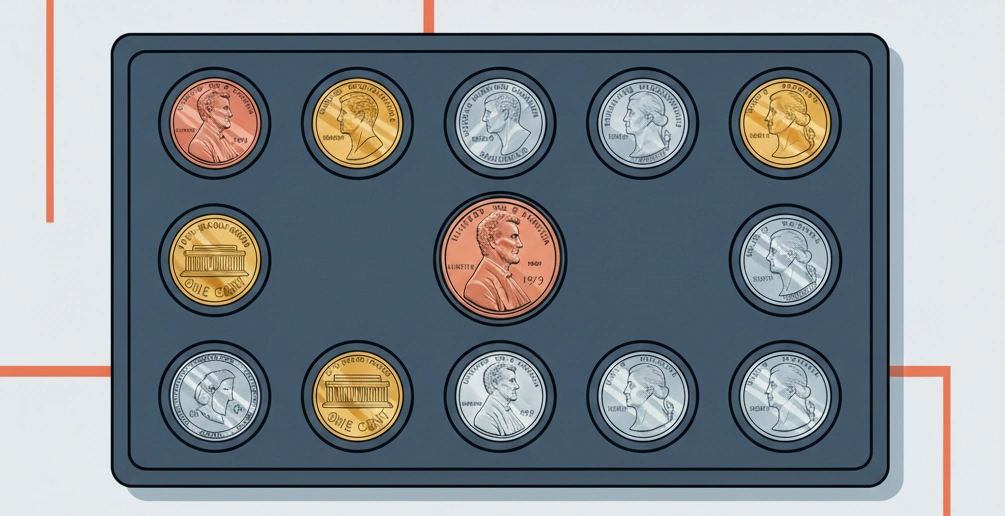
Myth #1
The Absence of a Mint Mark Is a Minting Error.
The most frequent misconception involves interpreting the lack of a letter under the date as a production defect.
According to official U.S. standards, coins struck at the main facility in Philadelphia traditionally lacked a mint mark (with the exception of the Susan B. Anthony dollar in 1979).
The absence of a mark represents a standard issue produced by the Philadelphia Mint.
The mintage of this facility in 1979 amounted to 6,018,515,000 specimens.
Such a high production volume precludes recognizing the missing mark as a rare anomaly.
Myth #2
A 1979 Penny Without a Mark Is Automatically Worth Thousands of Dollars.
Coin owners often overvalue common specimens, confusing them with rare varieties or errors.
The market value of most 1979 pennies from circulation ranges from 1 to 3 cents.
The real value of a coin is determined solely by its grade on the Sheldon scale.
Grade | Characteristics | Market Value (USD) |
G-VF (Circulated) | Significant wear, rubbed details | $0.01 – $0.02 |
MS 63 (Uncirculated) | Presence of luster, small scratches | $0.15 – $0.30 |
MS 65 (Gem RD) | High level of luster, minimum defects | $1.00 – $4.00 |
MS 67 (Superb Gem) | Nearly perfect preservation | $15.00 – $120.00 |
MS 68 (Top Pop) | Exceptional rarity in this grade | $1,000+ |
Myth #3
All 1979 Copper Coins Are Equally Valuable Due to Composition.
The composition of the 1979 coin (95% copper, 5% zinc) makes its weight (3.11 g) greater than that of coins produced after 1982 (2.5 g).
This creates a myth regarding high metal value.
Currently, the market value of the copper in a single coin is approximately 2.5–2.8 cents.
U.S. law prohibits the melting of coins for commercial purposes, limiting the realization of this value.
The weight difference between copper and zinc pennies creates no numismatic premium for the 1979 issue.
Factors Truly Increasing Value
Accurate evaluation requires considering specific characteristics confirmed by grading company certificates.
Color Classification (Red, Red-Brown, Brown): Coins marked RD (Red) cost 50–200% more than similar coins in the RB or BN categories.
Die State: Specimens struck with fresh dies having high relief are valued more highly.
Absence of Patina: Copper exposed to the environment loses numismatic appeal rapidly.
Auction Records
Record prices are recorded only for coins in MS 68 condition and higher, having passed certification at the coin value app, PCGS, or NGC.
In 2012, a 1979 specimen (No Mint Mark) in MS 68 RD condition was sold for $1,265 at Heritage Auctions.
In 2018, a similar coin was sold for $960, indicating price volatility in the high-end segment.
The price decrease in this case amounted to approximately 24% over six years, demonstrating dependence on the number of new top-quality specimens found.
Currently, the PCGS registry lists fewer than 20 specimens in MS 68 RD condition.

Myth #4
The Presence of "L" on Lincoln's Shoulder Is a Sign of Rarity.
Some sources erroneously point to the letter "L" (designer Brenner) as a rare feature.
This element is present on all Lincoln coins issued after 1918.
Its presence does not affect value and is not an error identifier.
Minting Errors Often Confused with Regular Coins
Actual technical defects exist, being frequently mistaken for common wear or, conversely, unique rarities.
Double Die: No major doublings (like the 1955 issue) have been recorded for 1979.
Minor doublings (Machine Doubling), occurring due to equipment vibration, possess no value.
Off-center Strike: Value depends on the displacement percentage.
Displacement (%) | Date Presence | Estimated Value (USD) |
5% | Yes | $2 – $5 |
25% | Yes | $15 – $40 |
50% | Yes | $75 – $200 |
50% | No | $5 – $15 |
The market for one-cent coins demonstrates a certain cyclicality.
For MS 67 specimens, the price has increased by an average of 12% over the last 10 years, representing about 1.2% annually.
Specimens graded MS 66 and lower show negative returns due to the increasing number of certified coins on the market.
The value drop in the MS 65 segment amounted to about 15% over the last 5 years due to excess supply.
How to Avoid Mistakes When Buying or Selling
Value identification must begin with a technical analysis of the surface under a microscope, or better — the free coin identifier app.
The presence of even a single microscopic scratch automatically moves a coin from the Superb Gem category to common Uncirculated.
Verifying authenticity through PCGS or NGC databases allows for excluding the risk of purchasing forged grades.
Using scales with 0.01 g precision helps distinguish an original copper planchet from potential fakes based on later zinc cores.
Context requires comparing Philadelphia metrics with other mints from the same year.
Mint Facility | Mint Mark | Mintage | Record (USD) |
Philadelphia | None | 6,018,515,000 | $1,265 |
Denver | D | 4,139,357,254 | $3,995 |
San Francisco | S (Proof) | 3,677,175 | $10,925 |
The high price of Denver coins in top grades is explained by the difficulty of preserving original red color on planchets from this mint in 1979.