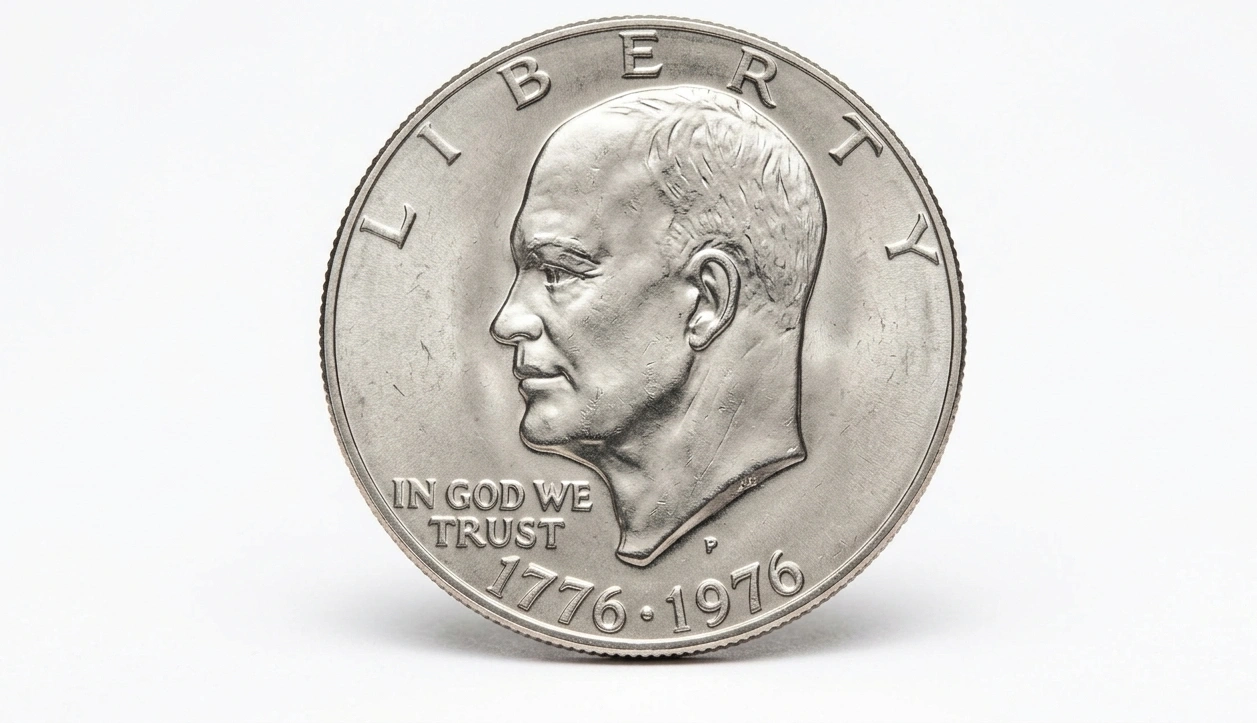
Most 1976 silver dollars look identical at first glance, yet their prices differ significantly.
This difference rarely lies where beginners expect.
The market 1976 silver dollar value today depends on a specific mix of metal content and minting errors.
Two distinct lettering styles on the back create the primary price gap for this year.
Verified data below explains the factors moving the needle in the current market.
Feature | Silver Version (40% Silver) | Copper-Nickel Version |
Total Weight | 24.59 grams | 22.68 grams |
Pure Silver Weight | 9.83 grams | 0 grams |
Thickness | 2.58 mm | 2.58 mm |
Diameter | 38.1 mm | 38.1 mm |
Mint Mark | San Francisco (S) | Philadelphia or Denver |
A visible brown or orange stripe on the edge confirms the coin has no silver.
A solid white edge acts as the first sign of real silver content.
Using high-precision scales prevents mistakes by catching fakes within 0.01 grams.
Identifying Back-Side Lettering Styles
The US Mint changed the font during the production year.
These edits created two types with different values.
Type I → Wide letters with a flat appearance.
Type II → Thin letters with deep, sharp edges.
Distribution logic:
Copper-nickel coins from Philadelphia/Denver → both types exist.
Silver coins from San Francisco → mostly Type II in Proof finish.
Type I silver coins are 20% harder to find.
Finding a Type I font on a silver coin increases the base price by 50% immediately.
Pricing by Grade
Surface condition drives the cost for 1976-S Silver Uncirculated coins.
Current market rates:
MS63 → $15
MS65 → $22
MS67 → $48
MS68 → $350
MS69 → $3,800
Values for MS68 coins grow by 6.5% every year.
Low-grade coins lose 2% of their value annually due to high supply.
High prices above the 67 level require a surface free of tiny scratches.
Auction Records and Top Sales
Record prices go to coins with zero flaws.
Reports from Heritage and Stack's Bowers confirm these numbers.
Specimen | Grade | Sale Price | Date of Sale |
1976-S Silver Type I | MS69 | $7,500 | January 2024 |
1976-S Silver Type II | MS69 | $3,150 | March 2025 |
1976-S Silver Proof | PR70 DCAM | $12,000 | June 2024 |
1976-D Copper-Nickel | MS67+ | $4,200 | October 2023 |
A PR70 grade demands a perfect mirror finish and frost-like details.
One tiny speck of dust caught under the strike drops the price to $200.
How Metal Prices Set the Floor
Silver market rates create a safety net for these coins.
Metal weight sets the value if collector interest fades.
2026 Metal Calculation:
9.83 grams of silver → current rate of $1.2 per gram → melt value $11.80.
Collector premiums for standard coins usually add 25% to 40% on top of this.
Owning silver dollars protects money from total loss during economic shifts.
Grading Hurdles and Expert Certification
Expensive deals require a formal paper from a lab.
The 2026 market ignores coins without plastic slabs if the price exceeds $100.
The expert review process:
Verifying metal content → 100% accuracy.
Checking the surface under 10x magnification and with the coin scanner app.
Judging the strike quality and image centering.
PCGS lab fees start at $45 per coin.
Shipping a coin for grading only makes sense for items likely to hit MS67 or better.
Profit Through Minting Mistakes
Errors at the mint create unique objects.
These items ignore standard price lists.
Wanted error types:
Double Strike → image appears twice → price from $500.
Off-center → part of the image is missing → price from $1,200.
Wrong Metal → struck on the wrong blank → price from $5,000.
Finding a silver dollar on a 22.68-gram blank proves a major material error occurred.
These mistakes gain 15% in value every year because their number is fixed.
Wear Analysis and Preserving Value
These coins were not meant for daily spending.
Most stayed in blue envelopes or special sets.
Ways a coin loses its grade:
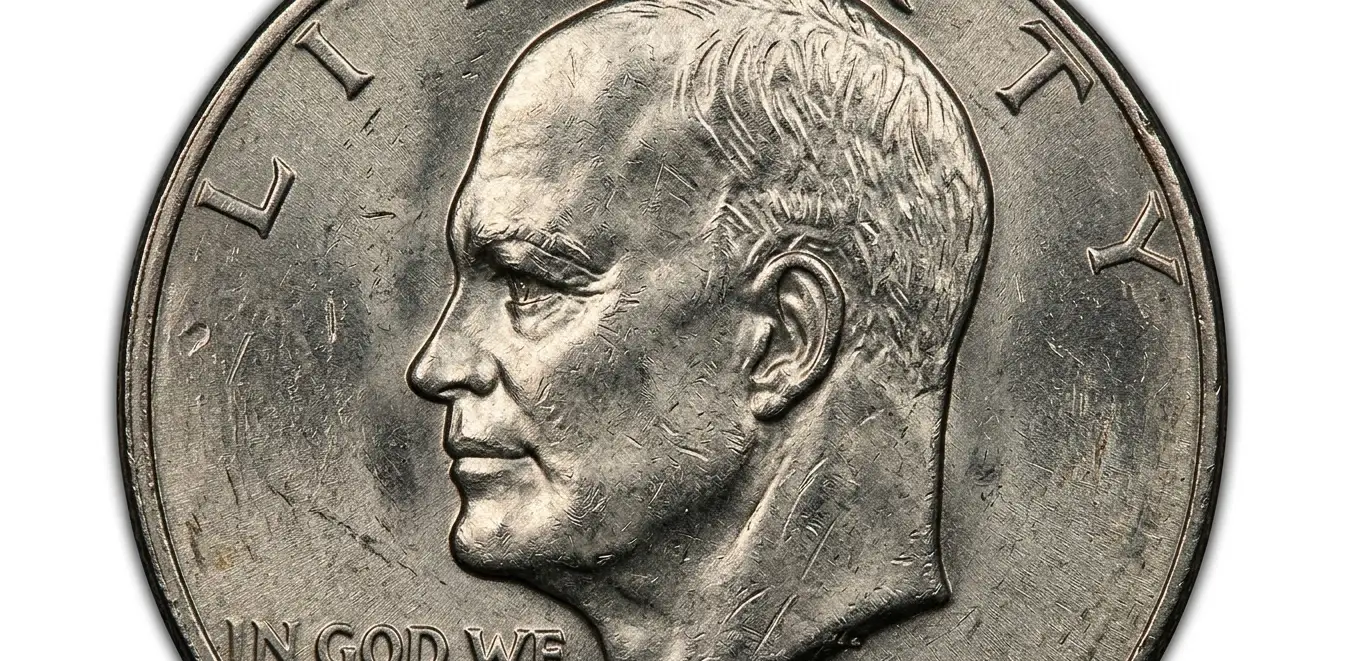
→ White "milk spots" on the silver → 30% price drop.
→ Black or green rust from bad plastic → 50% price drop.
→ Scuffs from coins rubbing together in bags.
Safe storage requires acid-free capsules.
Cleaning a coin with liquid chemicals destroys the collector value instantly — check yours via a free coin value checker app.
Sales Fees and Shipping Logistics
Selling a high-value coin costs money.
A seller’s final profit is always lower than the auction hammer price.
Example for a $1,000 sale:
Auction fee (15%) → $150.
Insurance and shipping → $35.
Past grading costs → $45.
Final cash in hand → $770.
Sales under $50 are more profitable on direct-selling websites.
Market Trends
The Eisenhower silver dollar market has stayed steady for six years.
This stability makes the coin a safe asset.
5-Year Price Changes:
Low grades (MS60-63) → 10% drop.
Mid grades (MS64-66) → 12% rise.
Top grades (MS68+) → 45% rise.
Investors in 2026 focus on top-tier items rather than common coins.
Dumping common material to buy rare spots is the current strategy.
Comparing Proof Coins
San Francisco produced all silver Proof coins.
Only 4,000,000 were made, which is very low for US coins.
Proof Coin Details:
Shiny background → reflects light like a mirror.
Dull image → looks like white frost on the portrait.
No marks → resulting from hand-fed production.
A basic 1976 Silver Proof costs $15 to $20 in 2026.
Deep Cameo labels double that price.
Rare Philadelphia Coins (No Mint Mark)
Copper-nickel dollars with no letter came from Philadelphia.
The mint made over 117 million of them.
High supply → no rarity → price stays at $1.05.
Only MS67 or better grades are worth real money.
Finding one in a wallet today is nearly impossible.